
LIVE REVIEW: Phoebe Bridgers at Moody Center
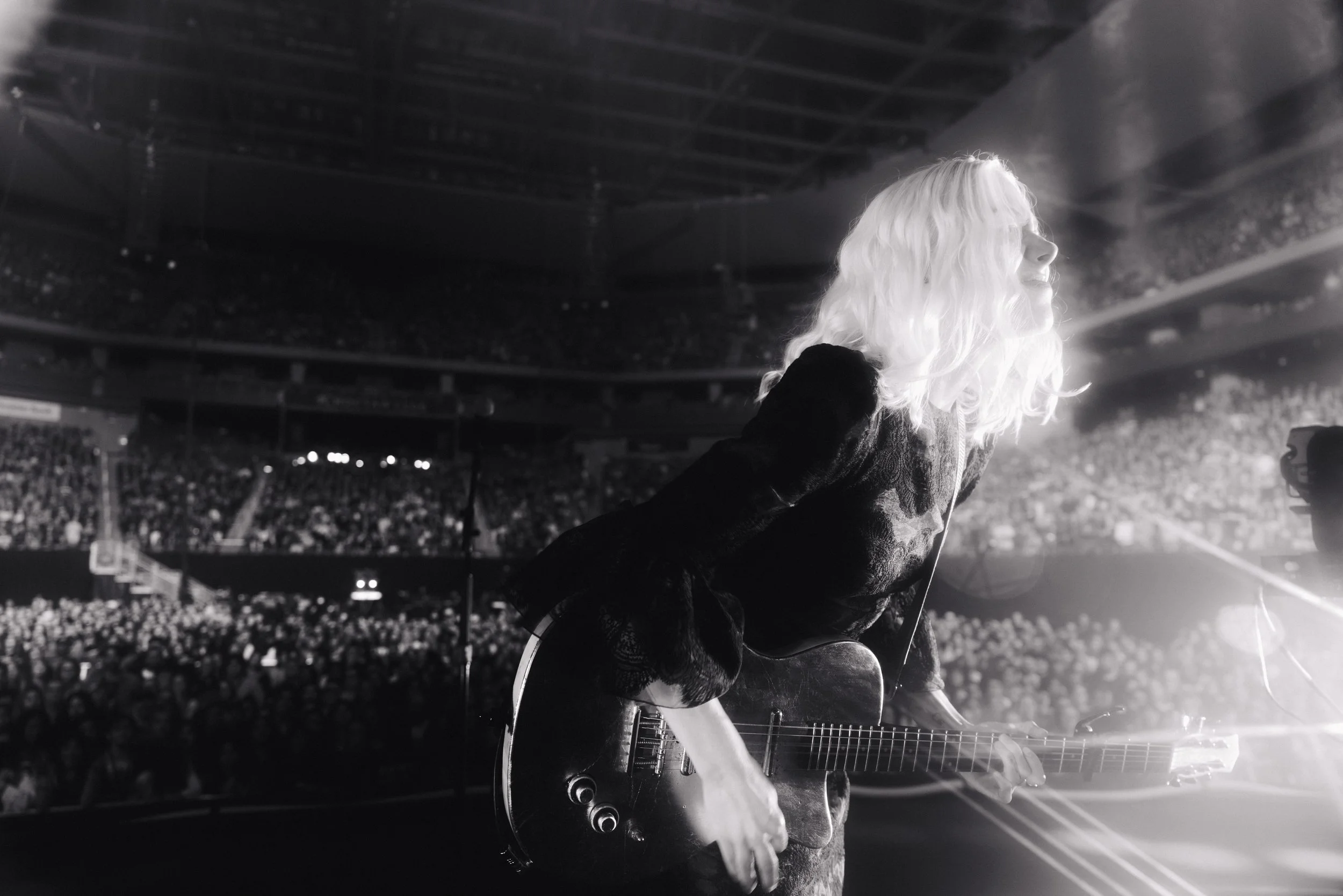
Photo Courtesy of Wes Ellis
AUSTIN, TX | MOODY CENTER | OCTOBER 16, 2026 | BY ERIC MARTINEZ
On October 16th, Phoebe Bridgers brought the lost boys of Austin to Moody Center, where thousands willingly surrendered their phones for an experience best preserved through memory, written notes, and hastily drawn sketches. With the release of her latest album, Lost Weekend, Bridgers took The Lost Tour across North America alongside longtime friend Alex G. Lines stretched around the venue and merch queues seemed endless, but the anticipation was undeniable. Fans arrived in skeleton onesies, boygenius-inspired suits, and alien antenna headbands, embracing the visual motifs that have long followed Bridgers’ musical identity.
Making my way through the crowds, I was met face-to-face with the inevitable Yondr pouch. The phone-free policy, which Bridgers opted into for the tour, has been growing in popularity, and it was one of the main aspects of the night I wasn't expecting to enjoy as much as I did. Without a phone to check every so often, I found myself aimlessly lost in time once I entered the venue. Still, I had my eyes set on the merch table and its carefully crafted clothing pieces designed by Shane Gelinas. It didn't take long for that time blindness to settle in as music erupted from within the venue while finishing my purchase, signaling the beginning of Alex G's set.
Met with a black ocean of screenless fans, Alex G opened the night with “Forever,” drawing from a discography that has cultivated a devoted following over the years. Having only been familiar with the singer-songwriter through tracks like “Sarah” and “Treehouse,” I wasn't entirely sure what to expect from his live performance. To my surprise, the set leaned into a more abstract direction than I had anticipated. Without a large projection of the singer towering over the performance hall, the set felt surprisingly intimate for a venue of Moody Center's size. The darkness seemed almost unnerving at first, but without the usual sea of fluorescent phone screens, the stage became the sole point of focus. Strobes flickered across the stage, occasionally resembling microscopic organisms suspended beneath a lens, while the lighting moved in tandem with the music. It was here that I began to have more of an appreciation for the Yondr pouches. Openers are often treated as background noise, an unfortunate habit that becomes much easier to indulge when a phone is within reach. With that distraction removed, I found myself and others paying closer attention to a performance that might otherwise have been overlooked.
G's self-proclaimed Austin anthem, “Blessings,” became one of the most memorable moments of his set. What initially felt understated had grown into something unexpectedly captivating, and by the time the song ended, it had become my favorite of his performances. Before leaving the stage, G thanked Bridgers for bringing him along on tour and took a moment to recognize the crew responsible for bringing the production to life. It was a thoughtful end to a set that had already shifted my expectations for the night.
It wasn't long before Bridgers' entrance caused an uproar throughout the venue. A hemisphere structure rose from the main stage, resembling an alien spacecraft emerging through clouds of smoke to reveal Bridgers and her band. The opening of “The Outside” transitioned into “Motion Sickness,” immediately establishing the scale of the production. Bridgers stunned in a black lace dress, glittering tears streaming down her cheeks, as the stage illuminated around her. The reveal was theatrical without feeling excessive, setting the tone for a night I would long for years to come. Among the crowd, two audience members dressed in glittering sheets to resemble ghosts caught the singer's attention, prompting a cheeky acknowledgment of their outfits. It was a fitting reference to her earlier album, Stranger in the Alps, before the set moved into “Lost Boys,” a track written alongside opener Alex G.
The hemisphere tilted to reveal its underside, where projections of planets, stars, and other celestial imagery stretched across the structure. Light beamed outward in every direction, transforming the stage into something resembling a distant galaxy. The production was enormous, yet Bridgers' presence remained strangely intimate. Amidst the darkness, lighters began igniting throughout the crowd, appearing like fireflies scattered across the countryside beneath a sky decorated with stars. The sight accompanied “Moon Song,” one of the night’s most sentimental moments. Without phones raised overhead, the tiny flames became all the more visible, and the audience seemed to move in unison with the music. Nothing was being recorded. There was no need to look through a screen to witness what was happening. It was enough to simply stand there and experience it.
Soon after, Bridgers made her way toward the smaller stage situated within the general admission pit. The rotating platform and shifting hemisphere continued to transform the space around her, while the production made the distance between the two stages feel almost inconsequential. Throughout the night, a live ensemble featuring fiddle, mandolin, bass, cello, and banjo added depth to the arrangements, giving the songs an expansive quality that extended beyond their recorded counterparts.
Bridgers eventually took a moment to thank the audience for their willingness to surrender their phones. She acknowledged how the absence of screens allowed the creative vision behind the tour to unfold without fluorescent displays interrupting the visuals. Rather than capturing the performance through a camera, the audience was left to experience it firsthand. It was a sentiment that had already begun to resonate with me, though hearing it from Bridgers herself made the intention behind the policy feel all the more apparent. The conversation soon shifted toward family, loss, and the complicated nature of grief. Asking the dads in the audience to make their presence known, Bridgers even acknowledged those who were no longer with us. The moment opened into a discussion of her relationship with her late father and the emotional weight of navigating grief after years of estrangement. She described the experience as something that continued to resurface, a cycle of mourning made more complicated by the history of their relationship and periods of no contact.
No show I've attended so far has felt as raw or visceral as this one. Bridgers spoke with a vulnerability that seemed to quiet the entire venue, allowing the audience to sit with her words before the music resumed. The conversation eventually expanded into the current political landscape, with Bridgers urging fans to vote as an act of rebellion. It was refreshing to hear an artist use the space between songs to acknowledge the world outside the venue, especially when so much of the night had felt removed from it. The moment culminated in “Still Standing,” and all I could hear around me were sniffles and the occasional sob. Grief, which had initially been introduced through a deeply personal story, had become something shared between the singer and thousands of strangers. Glitter and confetti drifted from above, while Bridgers walked along the barricade, reaching out to touch the hands of fans nearest to her. For all the elaborate staging surrounding the performance, it was these moments of direct connection that made the evening feel so close.
Returning to the main stage, Bridgers shifted the atmosphere once again. “Bobby” offered a gentler transition before “On Video” arrived with an intensity that completely transformed the venue. The band began headbanging beneath a deep red glow as smoke engulfed the stage, turning the performance into something far more aggressive than the celestial dreamscape that had opened the night. The enormous hemisphere, tilted at a near ninety-degree angle, resembled a black hole suspended above the musicians, threatening to swallow everything beneath it. Then came “Waiting Room.”
There are songs that feel devastating through headphones and songs that become something else entirely when thousands of people sing them together. As the crowd repeated, “Know it's for the better,” the venue erupted into a collective desperation that was impossible to ignore. I was sobbing inside, overwhelmed by the sheer intensity of the moment, caught between wanting to scream and trying to process what I was experiencing. Again, the absence of phones made the response around me feel almost surreal. Bridgers later introduced “Other Plans,” a song from Lost Weekend that she admitted she was nervous to perform. She joked about not wanting to mess it up, only to stumble over a couple of chords during the song itself. It was an endearing moment that briefly brought the scale of the production back down to earth. Beneath the elaborate staging and seemingly impossible visuals was a musician working through a new song in front of thousands of people, unafraid to let a mistake become part of the experience.
The night continued with “Kyoto,” building toward the inevitable eruption of “I Know the End.” A tornado stretched across the backdrop as the song intensified, its visuals growing increasingly chaotic alongside the music. By the time Bridgers shouted, “Man, I hate this part of Texas,” the audience was ready to answer with a scream of its own. What followed was deafening. Thousands of voices collided into one piercing collective release, filling the venue with a sound that felt almost physical. The fiddle solo cut through the chaos, the lighting intensified, and the tornado loomed behind the band as the performance reached its fever pitch. It was a moment of complete surrender, as though everyone in the room had been holding something in and had finally been given permission to let it go. When Bridgers left the stage, the crowd continued chanting for her return. After the intensity of “I Know the End,” it felt as though the evening had reached its natural conclusion. Instead, the audience was given one final opportunity to linger in the world she had created.
Bridgers returned to the smaller stage for “Scott Street,” dressed in a luminescent white gown with glittering tears still catching the light. The rotating platform carried her slowly through the crowd as thousands of voices sang back to her. Above the main stage, the enormous hemisphere lifted once again, revealing the celestial projections that had accompanied the beginning of the evening. Lighters reappeared throughout the venue, returning the crowd to a field of fireflies beneath the stars. Soon, the venue lighting grew so bright that I could make out the faces of people seated in the nosebleeds. Hands swayed from every corner of the venue, moving left and right in unison as Bridgers continued to sing. It felt as though we had died at the end of “I Know the End,” only to return to the afterlife for “Scott Street.”
For a concert built around such elaborate production, Bridgers' greatest achievement was making the experience feel so deeply human. The celestial visuals, rotating stages, smoke, and elaborate lighting were spectacular in their own right, but they never entirely overshadowed the intimacy of the music. There was room for grief, exhilaration, awkwardness, nostalgia, and the strange comfort of thousands of strangers feeling the same thing at once. By the end of the evening, the Yondr pouch that had initially felt like an inconvenience had become an unexpected part of what made the show so memorable. Without the ability to document every moment, I was left with the details that had stayed with me both in my notepad and memory.
Somewhere between the darkness of the opening set and the luminescence of “Scott Street,” Moody Center became something more than a concert venue. For a few hours, it felt like another world entirely, one that could only be understood by physically being there.
